hanchaoyang94@gmail.com
12 min read
hanchaoyang94@gmail.com
12 min read
Buying a used tractor can be a practical way for farmers, agricultural businesses, contractors, landscaping companies, construction operators, and equipment dealers to expand their machinery fleet while controlling investment costs.
Compared with purchasing a new tractor, buying used equipment can significantly reduce the initial purchase price and allow businesses to acquire additional equipment without taking on the cost of a brand-new machine.
However, many buyers ask the same question:
"Where is the best place to buy a used tractor?"
At first, the answer may seem simple:
Find the dealer or marketplace with the lowest price.
However, experienced buyers understand that the best place to buy a used tractor is not necessarily the place offering the lowest asking price.
The quality of the buying source can affect:
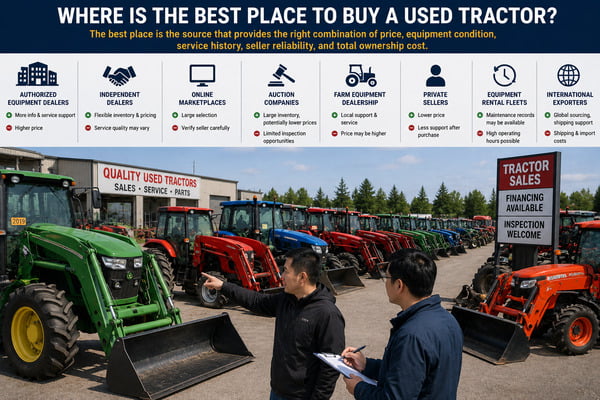
Buyers may find used tractors through:
Each option has different advantages and risks.
For example, a dealer may offer more vehicle information and service support, while a private seller may offer a lower price.
An auction may provide access to a large inventory, but buyers may have less opportunity to inspect equipment before bidding.
The best place to buy a used tractor is the source that provides the right combination of price, equipment condition, service history, seller reliability, and total ownership cost.
Before choosing where to buy a used tractor, buyers should understand one important point:
A tractor is not simply a piece of equipment.
It is a working business asset.
A reliable tractor can help businesses:
A poorly selected tractor can create:
Professional buyers therefore evaluate both where the tractor is purchased and what condition the tractor is actually in.
The better question is not:
"Where can I find the cheapest tractor?"
The better question is:
"Where can I find a reliable tractor at a reasonable total cost?"
There is no single source that is best for every buyer.
The right purchasing channel depends on:
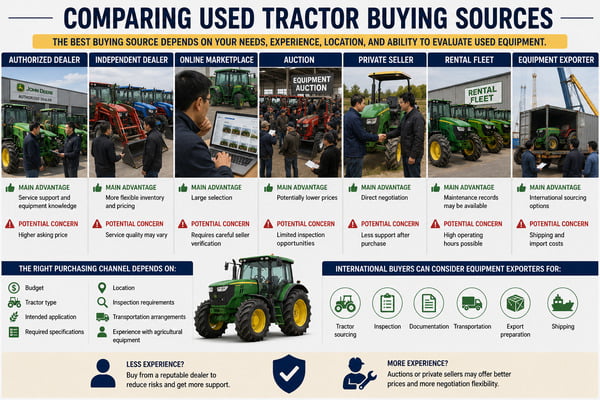
Common purchasing sources include:
| Buying Source | Main Advantage | Potential Concern |
|---|---|---|
| Authorized dealer | Service support and equipment knowledge | Higher asking price |
| Independent dealer | More flexible inventory and pricing | Service quality may vary |
| Online marketplace | Large selection | Requires careful seller verification |
| Auction | Potentially lower prices | Limited inspection opportunities |
| Private seller | Direct negotiation | Less support after purchase |
| Rental fleet | Maintenance records may be available | High operating hours possible |
| Equipment exporter | International sourcing options | Shipping and import costs |
Each option can work well under the right circumstances.
For buyers with limited equipment knowledge, purchasing from a reputable dealer may reduce some risks.
Experienced buyers who understand tractor mechanics may be more comfortable purchasing through auctions or private sellers.
International buyers may also consider equipment exporters that can help coordinate:
The best buying source depends on the buyer's needs, experience, location, and ability to evaluate used equipment.
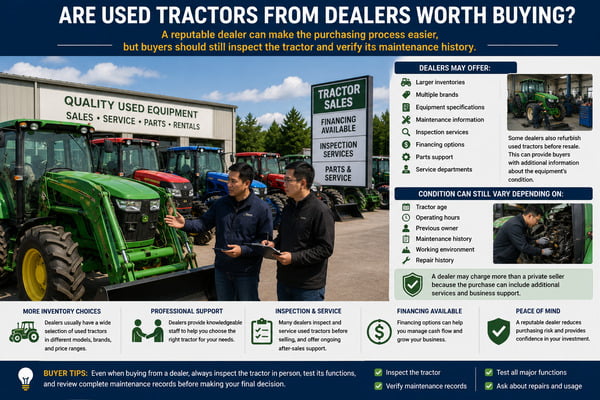
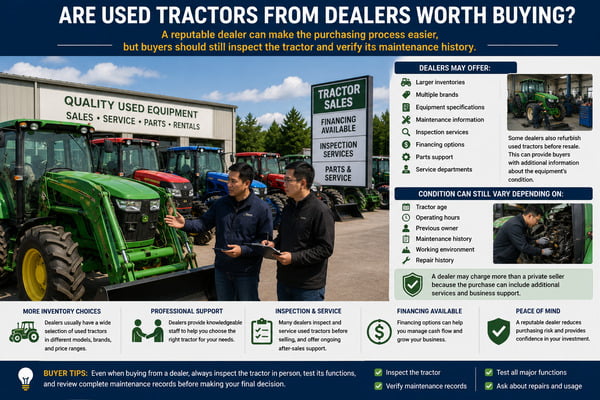
Equipment dealers are one of the most common places to purchase used tractors.
Dealers may offer:
Some dealers also refurbish used tractors before resale.
This can provide buyers with additional information about the equipment's condition.
However, buyers should not assume that every dealer tractor is automatically reliable.
The actual condition can still vary depending on:
A dealer may charge more than a private seller because the purchase can include additional services and business support.
For buyers who prioritize convenience and lower purchasing risk, the additional cost may be worthwhile.
A reputable dealer can make the purchasing process easier, but buyers should still inspect the tractor and verify its maintenance history.
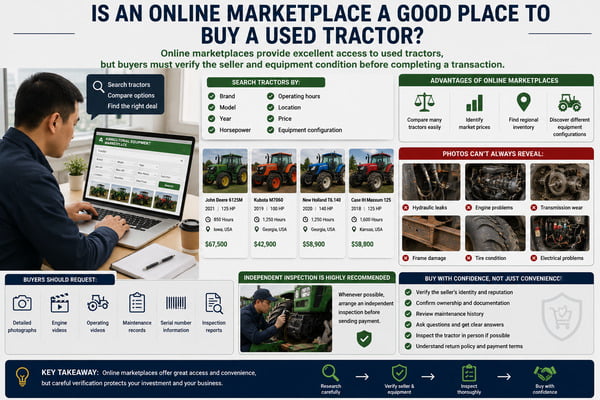
Online marketplaces have become an important source for used agricultural equipment.
Buyers can search for tractors based on:
One major advantage is the ability to compare many tractors without visiting multiple dealerships.
Online platforms can help buyers identify:
However, online purchases require additional caution.
Photos cannot always reveal:
Buyers should request:
Whenever possible, buyers should arrange an independent inspection before sending payment.
Online marketplaces provide excellent access to used tractors, but buyers must verify the seller and equipment condition before completing a transaction.
Equipment auctions can provide access to a large selection of used tractors.
Potential advantages include:
Some tractors may sell below traditional dealer asking prices.
However, auctions can also create additional purchasing risks.
Depending on the auction, buyers may have limited opportunities to:
Some auction equipment may also have:
Buyers should understand the auction's inspection and return policies before bidding.
They should also calculate:
A tractor that appears inexpensive at auction may become expensive after additional costs are added.
An auction can be a good source for experienced buyers who know how to evaluate equipment and calculate total acquisition costs.
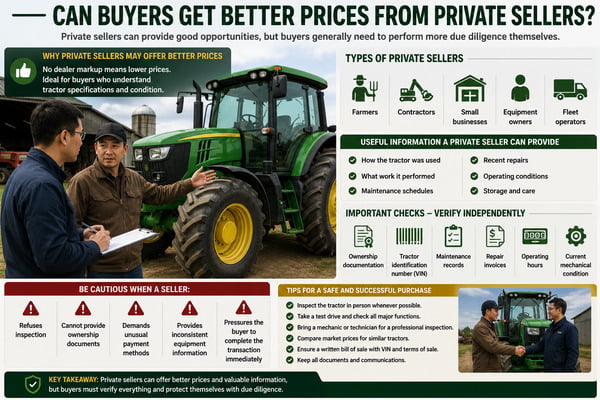
Private sellers may offer attractive prices because there is no traditional dealer markup.
This can be useful for buyers who already understand tractor specifications and mechanical condition.
Private sellers may include:
A private seller may also provide useful information about:
However, buyers should verify all information independently.
Important checks include:
Buyers should also be cautious when a seller:
Private sellers can provide good opportunities, but buyers generally need to perform more due diligence themselves.
Finding the right seller is only part of the purchasing process.
Buyers also need to select the right tractor for their application.
Common used tractor categories include:
Different applications require different specifications.
For example:
A compact tractor may be suitable for:
A larger farm tractor may be better suited for:
A high-horsepower tractor may be necessary for demanding applications requiring significant pulling power.
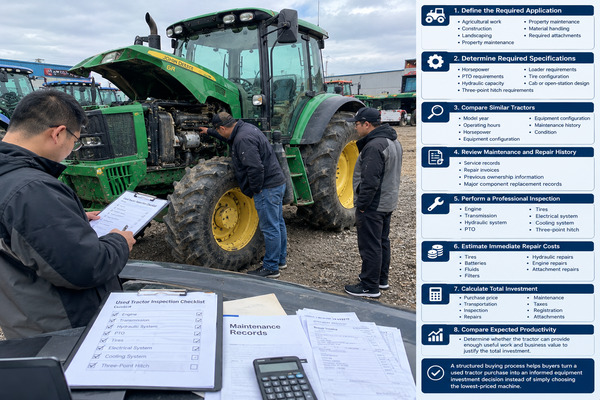
Buyers should consider:
The best used tractor is not necessarily the largest or cheapest model. It is the tractor that matches the equipment, workload, and operating environment.
Condition is one of the most important factors when purchasing a used tractor.
Two tractors with the same model year can have completely different values.
Buyers should inspect:
Potential problems may include:
Buyers should also inspect the tractor under operating conditions whenever possible.
A tractor that looks excellent in photographs may perform poorly when placed under load.
Physical inspection and operating performance are more important than appearance alone.
Operating hours are similar to mileage on a truck.
They provide useful information about how much the equipment has been used.
However, operating hours should not be evaluated by themselves.
A tractor with higher hours may still provide excellent value if it has:
A tractor with fewer hours may still have problems if it was:
Buyers should compare operating hours with:
For example:
A tractor with 7,000 hours and complete service records may be a better investment than a tractor with 4,000 hours and unknown maintenance history.
Operating hours are important, but maintenance history and actual mechanical condition provide a more complete picture of tractor value.
Maintenance records can provide valuable information about the tractor's previous life.
Buyers should request records for:
Maintenance documentation can help buyers identify recurring problems.
For example:
If a hydraulic pump has been replaced several times, buyers may want to investigate whether there is an underlying issue.
If major components have been properly serviced according to recommended intervals, the tractor may provide greater confidence.
Useful documents may include:
Complete maintenance records can help buyers understand both the tractor's past and its potential future repair requirements.
Price comparison should be based on similar equipment.
Buyers should compare tractors with similar:
For example:
A 150-horsepower tractor with 5,000 operating hours should not be directly compared with a 250-horsepower tractor with 2,500 hours.
Equipment configuration can create significant price differences.
Buyers should also consider included attachments.
A tractor sold with:
may have a higher price but provide greater business value.
The correct comparison is between similar tractors with similar specifications and conditions, not simply between the lowest advertised prices.
The purchase price is only one part of the total investment.
Additional costs may include:
For international buyers, additional costs may include:
For example:
A tractor may be advertised for $40,000.
After purchase, the buyer may discover that it requires:
The final investment could therefore be significantly higher than the advertised price.
Professional buyers calculate the total acquisition cost before making a final decision.
The true cost of a used tractor includes everything required to inspect, transport, repair, and put the equipment into productive operation.
Before purchasing, buyers should evaluate the seller as carefully as the equipment.
Important questions include:
Buyers should also compare several sellers instead of immediately choosing the cheapest option.
A reliable seller should be willing to provide accurate information about:
For international transactions, clear communication is especially important.
Buyers may need assistance with:
A trustworthy seller should make it easier for buyers to understand what they are purchasing rather than relying on price alone.
So, where is the best place to buy a used tractor?
There is no single answer for every buyer.
The best source depends on:
Dealers can provide inventory, service resources, and professional support.
Online marketplaces can provide a large selection and convenient price comparison.
Auctions may offer competitive prices but require stronger inspection and bidding discipline.
Private sellers can sometimes provide attractive deals, but buyers need to conduct more due diligence.
International equipment exporters can be useful for buyers who need assistance with sourcing, inspection, transportation, and shipping.
Regardless of where the tractor is purchased, buyers should evaluate:
The most important question is not:
"Where can I buy the cheapest used tractor?"
It is:
"Where can I find the right tractor from a reliable source at a reasonable total cost?"
The best place to buy a used tractor is the place that gives you confidence in the equipment, the seller, the documentation, and the total investment.
Tell us your requirements — brand, horsepower, year and quantity — and we'll match the right option for you.