hanchaoyang94@gmail.com
13 min read
hanchaoyang94@gmail.com
13 min read
Buying a tractor is an important investment decision for farmers, agricultural businesses, contractors, landscaping companies, construction operators, equipment dealers, and independent property owners.
A tractor can be used for many different types of work, including:
However, purchasing a new tractor can require a significant financial investment.
Because of this, many buyers consider purchasing used equipment.
This leads to an important question:
"Are used tractors worth buying?"
The short answer is:
Yes, a used tractor can be worth buying—but only when its condition, maintenance history, operating hours, configuration, and purchase price make sense for the buyer's needs.
At first, buying a used tractor may appear to be a simple way to save money.
A used machine usually has a lower purchase price than a comparable new tractor.
However, experienced equipment buyers understand that the purchase price is only one part of the investment.
The real value of a used tractor depends on many factors, including:
For example:
A used tractor priced at $30,000 may appear to be a better deal than another tractor priced at $40,000.
However, if the cheaper tractor requires:
the final investment may quickly exceed the cost of the better-maintained machine.
A more expensive used tractor with complete maintenance records and strong mechanical condition may provide significantly better long-term value.
A used tractor is worth buying when the savings at purchase are greater than the additional risks, repair costs, and maintenance expenses associated with owning older equipment.
Before deciding whether a used tractor is worth buying, buyers should understand one important point:
A tractor is not simply a piece of equipment.
It is a business and productivity asset.
A reliable tractor can help a business:
A poorly selected tractor can create:
Professional buyers therefore evaluate the total value of the machine rather than focusing only on the advertised price.
The better question is not:
"How cheap is this used tractor?"
The better question is:
"How much useful work and remaining service life can this tractor provide after purchase?"
The value of a used tractor comes from its ability to operate reliably and productively—not simply from having a low purchase price.
One of the biggest advantages of purchasing used equipment is the potential reduction in initial investment.
A used tractor may cost significantly less than a comparable new machine.
The amount buyers can save depends on:
A relatively new used tractor may still provide:
while costing less than a brand-new machine.
Older tractors may be even more affordable.
However, older equipment can also have:
The important comparison is not simply:
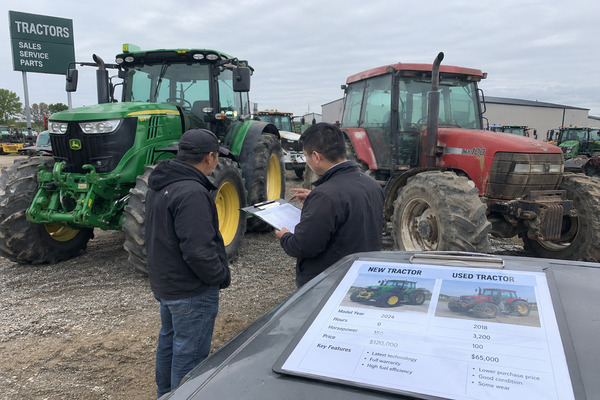
New tractor price vs used tractor price
Instead, buyers should compare:
Total investment vs expected productivity and remaining service life
For example:
A newer used tractor may have:
An older tractor may have:
The cheaper machine may not necessarily provide the better financial result.
The money saved at purchase only creates value if the tractor can continue operating reliably after the purchase.
Buying a used tractor can provide several important advantages.
The most obvious benefit is the lower purchase price.
A lower initial investment can help buyers:
This can be particularly useful for:
New equipment can experience significant depreciation during its early years.
A used tractor has already experienced part of this initial depreciation.
Depending on the machine and market conditions, this can make used equipment an attractive option for buyers who want to control investment costs.
The used market may provide access to tractors from many different production years and configurations.
Buyers may compare:
Buyers may also find machines equipped with:
For agricultural businesses and equipment operators, buying used tractors can make it easier to add machinery capacity.
Instead of investing all available capital into one new machine, a business may be able to purchase multiple used machines or combine a used tractor purchase with other equipment investments.
Older tractor models may have a long operating history.
This can help experienced buyers understand:
A well-known tractor model with a strong reputation and good parts support may be a practical used equipment purchase.
A used tractor can provide an attractive combination of lower investment and useful operating capability when the machine is properly selected and inspected.
Used equipment can provide good value, but buyers should also understand the potential risks.
The biggest concern is that the buyer may inherit mechanical problems from the previous owner.
Potential problems can include:
The risk level can depend heavily on the tractor's previous working environment.
For example:
A tractor used for light property maintenance may experience very different wear compared with a machine used for:
A machine with a low purchase price may require significant repairs before it can return to productive operation.
This is why buyers should avoid making decisions based only on:
A used tractor can become an expensive purchase if buyers do not identify mechanical problems before completing the transaction.
Operating hours are one of the first things buyers should check.
However, operating hours should not be evaluated by themselves.
A tractor with higher operating hours may still provide good value if it has:
A lower-hour tractor may still have problems if it experienced:
Buyers should consider operating hours together with:
For example:
A tractor with 5,000 hours that received professional maintenance may be a better purchase than a 3,000-hour tractor with no service history.
Operating hours are important, but maintenance quality and mechanical condition often provide a more complete picture of a used tractor's real value.
Maintenance history can be one of the most valuable sources of information for used equipment buyers.
A well-documented service history can help buyers understand how the tractor was maintained.
Important records may include:
A tractor with complete maintenance records may provide greater buyer confidence.
For example:
If a seller can demonstrate that the tractor recently received:
the buyer may have a clearer understanding of the machine's current condition.
However, maintenance records should not completely replace a physical inspection.
A professionally maintained tractor can still develop mechanical problems.
Maintenance history helps buyers understand the machine's past, while a professional inspection helps evaluate its current condition.
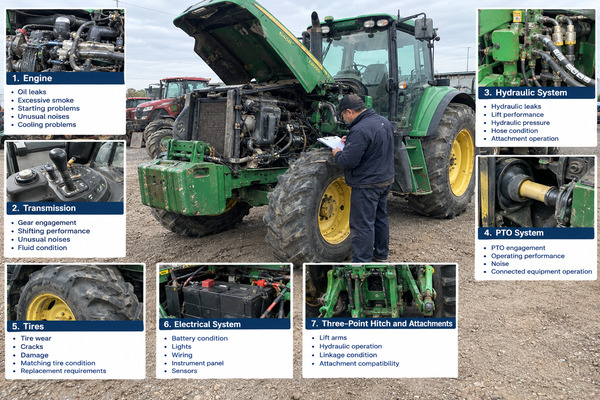
A professional inspection can help buyers identify potential repair costs before purchase.
Important areas include:
Inspect for:
Check:
Inspect:
If the buyer plans to operate equipment using a PTO, check:
Check:
Tires can represent a significant additional cost.
Inspect:
If applicable, inspect:
A complete inspection can help buyers estimate the real cost of ownership before purchasing a used tractor.
Brand can influence the value of a used tractor.
However, buyers should not choose equipment based only on the brand name.
Important considerations include:
A tractor from a well-known brand may provide advantages if replacement parts and qualified technicians are available in the buyer's region.
However, even a popular tractor brand can become a poor investment if the specific machine has:
Buyers should evaluate the specific tractor rather than assuming that every machine from a reputable manufacturer is automatically a good purchase.
Brand reputation can influence resale value and parts support, but the individual tractor's condition remains one of the most important factors.
Both older and newer used tractors can provide value.
The better choice depends on the buyer's budget and operating requirements.
A newer used tractor may offer:
However, it may also require a higher purchase price.
An older tractor may offer:
However, older machines may require:
The best choice is not automatically the newest or oldest machine.
Buyers should choose the tractor that provides the best balance between purchase price, mechanical condition, operating capability, and expected remaining service life.
The purchase price is only one part of the total investment.
Buyers should also consider:
For international buyers, additional expenses may include:
For example:
A used tractor may be advertised at an attractive price.
However, after purchase, the buyer may need to spend additional money on:
The final investment may therefore be significantly higher than the original purchase price.
The true cost of a used tractor is the total amount required to purchase, transport, repair, maintain, and operate the machine—not simply the advertised selling price.
A used tractor can be a good investment when several important factors are favorable.
A strong purchase opportunity may include:
The tractor should also match the intended work.
For example:
A small property owner may not need a large high-horsepower agricultural tractor.
A major farm operation may require more power and hydraulic capacity than a compact tractor can provide.
Buying the wrong size or configuration can reduce the value of the investment.
The best used tractor is not necessarily the cheapest tractor. It is the machine that can perform the required work reliably at an acceptable total cost.
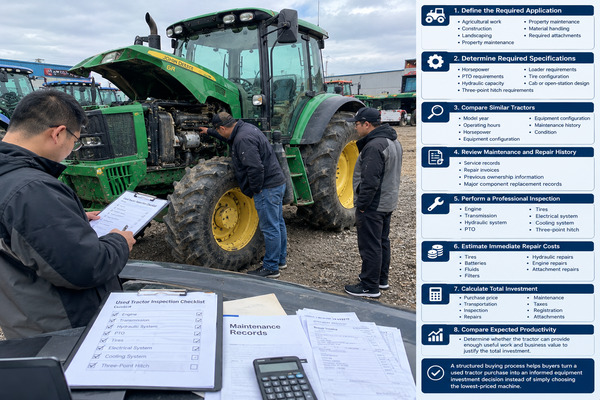
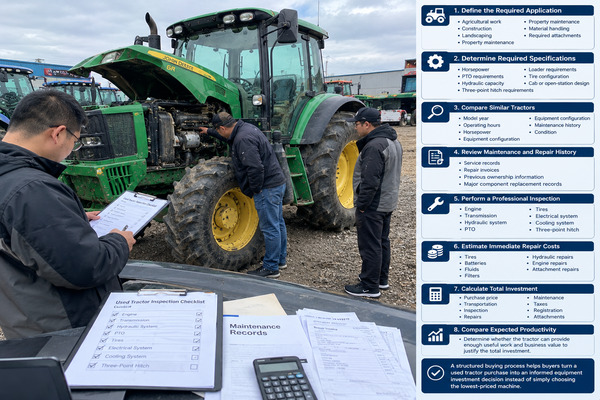
Before completing a purchase, buyers can follow a structured evaluation process.
Determine:
Consider:
Compare equipment with similar:
Request:
Inspect:
Calculate potential expenses for:
Combine:
Finally, determine whether the tractor can provide enough useful work and business value to justify the total investment.
A structured buying process helps buyers turn a used tractor purchase into an informed equipment investment decision instead of simply choosing the lowest-priced machine.
So, are used tractors worth buying?
Yes, they can be.
A used tractor can provide:
However, buying used equipment also involves potential risks.
Buyers should carefully evaluate:
The most important point is simple:
A low purchase price does not automatically mean a good deal.
A well-maintained used tractor with strong mechanical condition may provide years of productive service.
A cheaper tractor with hidden mechanical problems may quickly become an expensive investment.
Buying a used tractor is worth it when the machine's condition, configuration, remaining service life, and total ownership cost make financial and operational sense for the buyer's specific needs.
Tell us your requirements — brand, horsepower, year and quantity — and we'll match the right option for you.