hanchaoyang94@gmail.com
Updated August 12, 2026
7 min read
hanchaoyang94@gmail.com
Updated August 12, 2026
7 min read
Buying a used semi-truck can be a smart way for fleet owners, transportation companies, and independent operators to reduce investment costs while expanding their business.
However, not every used truck represents a good opportunity.
Many buyers focus on finding the lowest price, but the cheapest truck is not always the most economical choice.
A used truck with hidden mechanical problems, poor maintenance history, or unsuitable specifications can quickly become a financial burden after purchase.
Many buyers ask the same question:
"What used trucks should I stay away from?"
The answer is not simply about avoiding a specific brand or model.
A truck that works well for one operation may create problems in another environment.
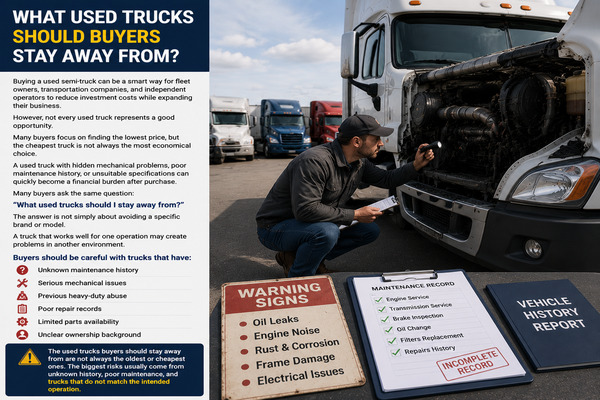
Buyers should be careful with trucks that have:
The used trucks buyers should stay away from are not always the oldest or cheapest ones. The biggest risks usually come from unknown history, poor maintenance, and trucks that do not match the intended operation.
Before choosing a used truck, buyers should understand one important point:
A used truck purchase is not only about finding a low price.
It is a long-term business decision.
A truck that cannot maintain reliable operation may create:
Experienced buyers evaluate the complete condition of the truck instead of judging only by appearance or price.
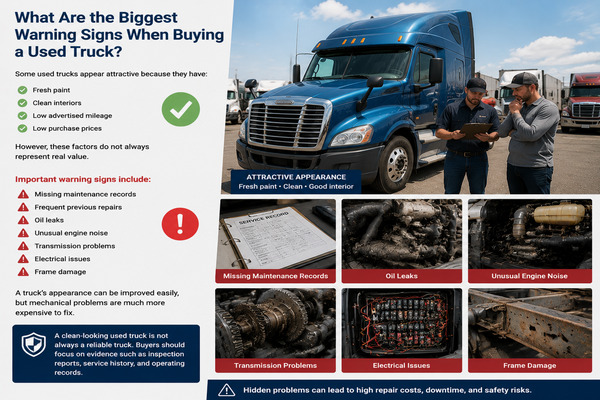
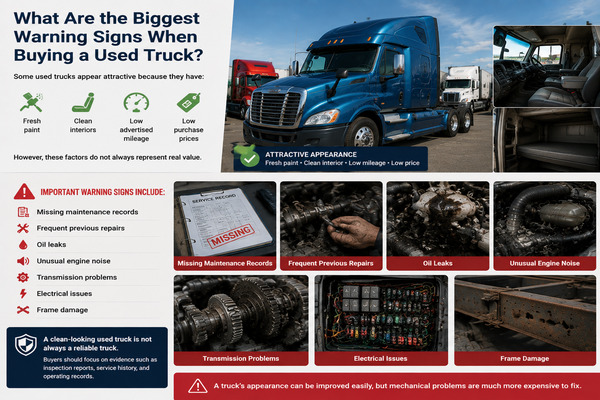
Some used trucks appear attractive because they have:
However, these factors do not always represent real value.
Important warning signs include:
A truck’s appearance can be improved easily, but mechanical problems are much more expensive to fix.
A clean-looking used truck is not always a reliable truck. Buyers should focus on evidence such as inspection reports, service history, and operating records.
Many buyers believe high mileage automatically means a truck should be avoided.
However, mileage alone does not determine reliability.
A higher mileage truck may still provide good value if it has:
However, buyers should be careful with trucks that have:
For example, a highway truck with higher mileage may sometimes be a better investment than a low-mileage truck used in demanding conditions.
Mileage is only one factor. Maintenance history and operating environment often provide more useful information about future reliability.
Different truck applications create different levels of wear.
Buyers should carefully evaluate trucks that were used for:
Heavy-duty applications can create additional stress on:
Construction trucks may experience:
Some trucks may have been operated with delayed servicing.
Potential problems include:
A truck’s previous working environment is just as important as its age and mileage. Buyers should understand how the truck was used before purchasing.
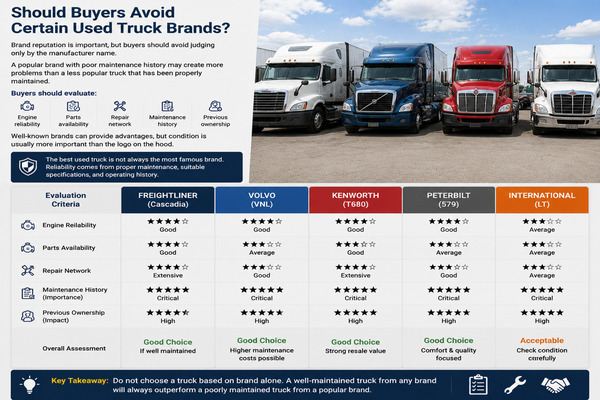
Brand reputation is important, but buyers should avoid judging only by the manufacturer name.
A popular brand with poor maintenance history may create more problems than a less popular truck that has been properly maintained.
Buyers should evaluate:
Well-known brands can provide advantages, but condition is usually more important than the logo on the hood.
The best used truck is not always the most famous brand. Reliability comes from proper maintenance, suitable specifications, and operating history.
No.
A lower-priced used truck can still be a good investment if:
However, buyers should be careful when a truck is significantly cheaper than similar vehicles.
A very low price may indicate:
A cheap purchase price does not create value by itself. The best deal is a truck that provides reliable operation after purchase.
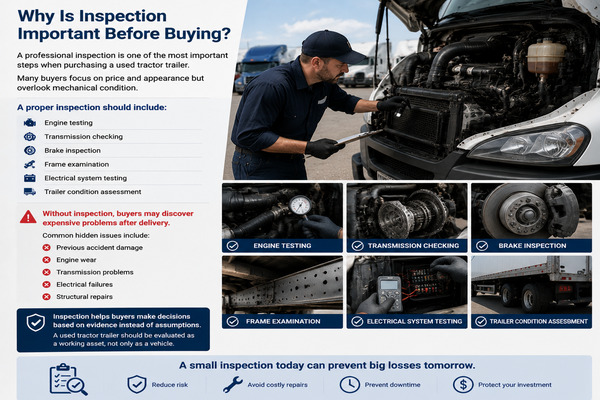
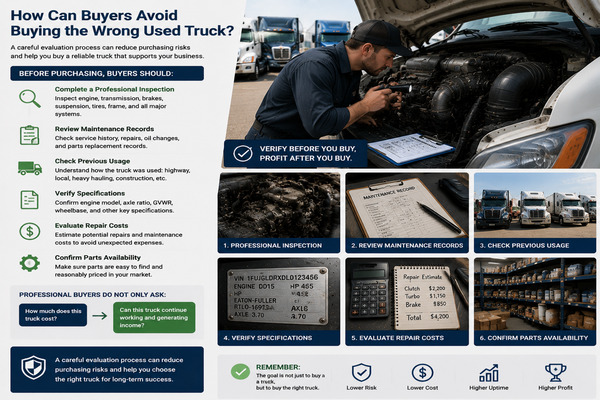
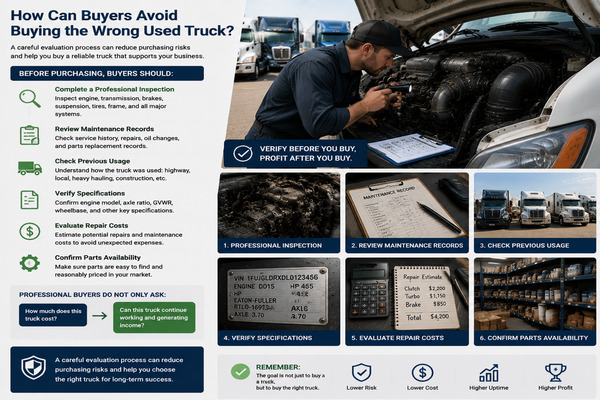
Before purchasing, buyers should:
Professional buyers do not only ask:
"How much does this truck cost?"
They ask:
"Can this truck continue working and generating income?"
A careful evaluation process can reduce purchasing risks.
Instead of focusing only on avoiding bad trucks, buyers should look for vehicles with:
A reliable used truck usually has predictable operating costs and fewer unexpected problems.
The safest used truck purchase is one based on verified information, not assumptions or attractive pricing.
No.
Age alone does not determine reliability. A well-maintained older truck can sometimes provide better value than a newer truck with poor history.
Not always.
However, buyers should investigate why the truck is priced lower and evaluate possible repair costs.
Not necessarily.
A high mileage truck with strong maintenance records may be more reliable than a low mileage truck with unknown history.
The biggest risk is usually unknown condition.
Hidden mechanical problems and incomplete maintenance history can create expensive problems after purchase.
So, what used trucks should buyers stay away from?
The answer is not simply a specific brand, model, or mileage range.
Buyers should be careful with trucks that have:
The best used truck is not always the newest or cheapest option.
It is the truck that matches your business needs, has verified condition, and can continue operating reliably after purchase.
At Deli Auto, we help customers evaluate used trucks through vehicle inspection, condition assessment, export preparation, and professional purchasing support.
Our goal is not only to provide affordable trucks.
Our goal is to help customers choose reliable commercial vehicles that create long-term business value.
Tell us your requirements — brand, horsepower, year and quantity — and we'll match the right option for you.