hanchaoyang94@gmail.com
15 min read
hanchaoyang94@gmail.com
15 min read
Buying a semi-truck is a major financial decision for owner-operators, trucking companies, freight carriers, and new transportation businesses.
A semi-truck can cost tens of thousands of dollars for an older used model and well over $100,000 for many newer used or new trucks.
Because of the high purchase price, many buyers choose to finance their semi-truck instead of paying the entire amount in cash.
However, financing approval depends on several factors.
These can include:
This leads many first-time buyers to ask the same question:
"What credit score is needed for a semi-truck?"
There is no single credit score that guarantees approval.
Many semi-truck lenders prefer borrowers with credit scores in the mid-to-high 600s, while some lenders work with borrowers with scores in the 550s or lower when other parts of the application are strong. A higher credit score generally provides access to more financing options and better rates and terms.
For example:
Your credit score is important, but it is only one part of a semi-truck financing application.
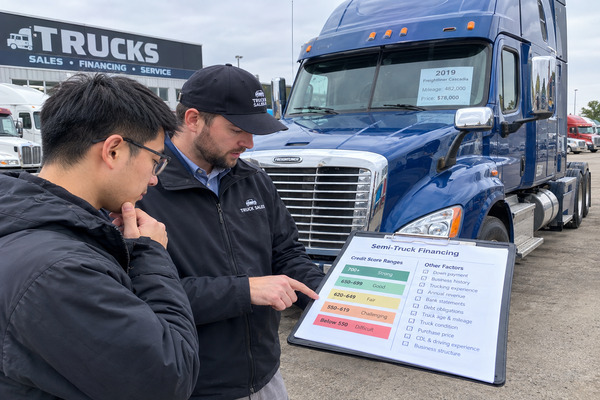
The most important thing to understand is that there is no universal minimum credit score for semi-truck financing.
Different lenders have different underwriting standards.
Some traditional lenders may prefer borrowers with stronger credit and established businesses.
Specialized commercial truck lenders may be more flexible and may consider borrowers with lower credit scores.
For example, current commercial truck financing programs show a wide range of requirements. Ameris Bank Equipment Finance lists a FICO score of 620 or more among its minimum requirements, while other commercial truck financing providers advertise programs starting around 550–625 depending on the applicant and transaction. Meeting a published minimum does not guarantee approval.
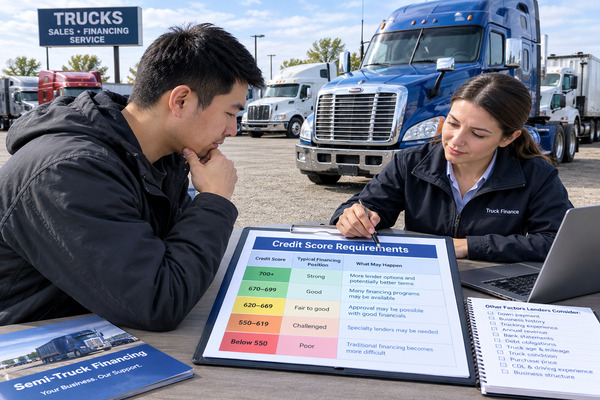
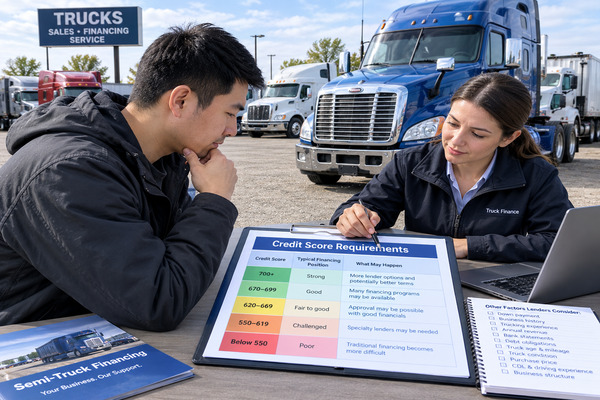
A practical way to think about credit scores is:
| Credit Score | Typical Financing Position | What May Happen |
|---|---|---|
| 700+ | Strong | More lender options and potentially better terms |
| 670–699 | Good | Many financing programs may be available |
| 620–669 | Fair to good | Approval may be possible with good financials |
| 550–619 | Challenged | Specialty lenders may be needed |
| Below 550 | Poor | Traditional financing becomes more difficult |
These ranges are general guidelines rather than guaranteed approval levels.
The same credit score can produce different financing results depending on the buyer, truck, business, and lender.
A credit score gives lenders information about your previous borrowing and repayment behavior.
When a lender finances a semi-truck, the lender is taking on the risk that the borrower may not make the required payments.
A stronger credit history can make the borrower appear less risky.
This can help with:
For example:
A buyer with a strong credit history may qualify for a larger percentage of financing and more competitive terms.
A buyer with weaker credit may still be approved, but the lender could require a larger down payment or charge a higher interest rate.
Bankrate notes that credit scores of 670 and above are generally considered good, while higher scores can improve the likelihood of receiving more competitive financing terms.
This is particularly important when financing an expensive commercial vehicle.
Even a small difference in interest rate can significantly affect the total cost of a semi-truck loan.
A higher credit score does not simply improve your chances of approval—it can also reduce the cost of borrowing.
Yes, it may be possible.
A 600 credit score does not automatically prevent you from financing a semi-truck.
However, your financing options may be more limited compared with a borrower who has a credit score of 700 or higher.
A lender may look more closely at:
For example:
A buyer with a 600 credit score and strong business revenue may have a better financing profile than a buyer with a 680 credit score but no business history and significant existing debt.
Some lenders specifically advertise financing programs for borrowers with credit scores around 600 or lower, although these programs can come with different terms and requirements.
A 600 credit score may be workable, but you should expect fewer choices and potentially higher borrowing costs.
Yes, but it can be more difficult and more expensive.
Some specialized commercial truck lenders work with borrowers who have less-than-perfect credit.
However, bad credit may affect the structure of the financing.
A lender may require:
For example:
A borrower with poor credit may have difficulty financing a $200,000 truck with a small down payment.
The same borrower may have a better chance of financing a less expensive used truck with a substantial down payment.
This is because the lender's overall exposure is lower.
Bad credit does not necessarily mean you cannot finance a semi-truck, but it usually means you need a stronger overall financing package.
The down payment is another major factor in semi-truck financing.
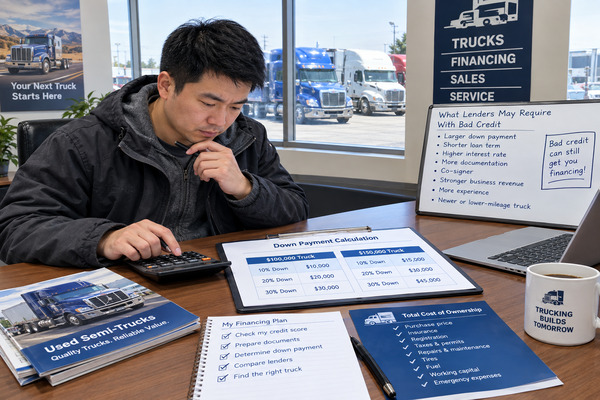
Many lenders expect buyers to put approximately 10% to 20% down, although the actual requirement can vary significantly based on credit, business history, truck condition, and lender. Buyers with weaker credit may be asked for more.
For example:
If a semi-truck costs $100,000:
If the truck costs $150,000:
A larger down payment can reduce the amount that needs to be financed.
It can also help strengthen an application when the buyer's credit score is not ideal.
However, buyers should not use all of their available cash for the down payment.
A trucking business may also need money for:
The best down payment is not necessarily the largest possible down payment—it is one that balances financing approval with sufficient business cash reserves.
Yes.
Credit score is only one part of the lender's decision.
Lenders may also want to know how long your business has been operating.
An established trucking company with several years of financial records can provide more information about its ability to repay the loan.
A new trucking company has less historical financial information.
This can make financing more difficult.
Some lenders prefer businesses with one or two years or more of operating history, while other commercial truck lenders are willing to work with startups or newer businesses.
For a new business, other factors may become more important.
These can include:
For example:
A first-time business owner with excellent credit, significant trucking experience, and a large down payment may have a stronger application than a new operator with poor credit and no industry experience.
New businesses may need to compensate for limited business history with stronger credit, more cash, or more experience.
Yes.
The truck itself is also an important part of the financing decision.
A semi-truck is usually used as collateral for the loan.
If the borrower stops making payments, the lender may need to repossess and sell the truck.
Therefore, lenders are generally concerned about:
Older trucks and high-mileage trucks can be more difficult to finance through some lenders.
For example:
A lender may be more comfortable financing a newer truck with 300,000 miles than an older truck with 900,000 miles.
Some commercial truck financing programs publish specific age or mileage restrictions, although these requirements vary by lender.
A strong credit score cannot always overcome an unsuitable truck.
It can.
Consider two buyers.
Both buyers have the same credit score.
However, Buyer A may present a lower-risk financing application because the loan amount is smaller relative to the truck price and the business has a stronger financial history.
This demonstrates why credit score alone does not determine approval.
Lenders typically evaluate the entire transaction.
The lender is evaluating both the borrower and the truck being financed.
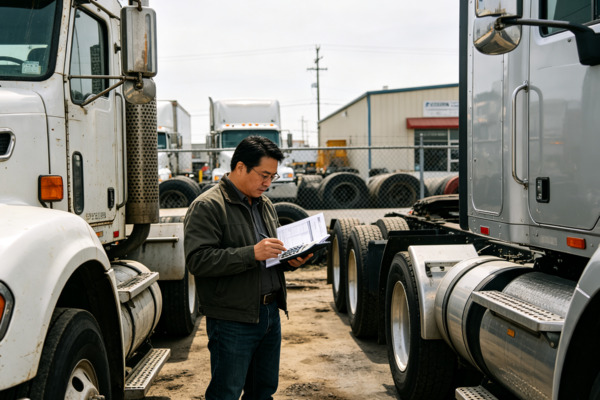
When applying for semi-truck financing, lenders may ask for financial and business documentation.
Depending on the lender, this can include:
Some lenders may also consider the applicant's trucking experience.
This can be particularly important for first-time owner-operators.
A lender wants to understand whether the borrower has the experience and income potential needed to operate the truck successfully.
A complete application can make it easier for a lender to evaluate the overall risk.
There is no single "perfect" credit score.
However, a higher credit score generally gives a buyer more options.
A practical target for many buyers is 670 or higher, while 700+ can put the borrower in a stronger position for competitive financing.
This does not mean that someone with a 650 score cannot buy a semi-truck.
It simply means that improving credit before applying may provide additional options.
For example:
Financing may be available through specialized lenders, but the borrower may face stricter terms.
Some commercial truck financing options may be available, especially with strong income and a reasonable down payment.
This is a stronger range and may provide access to more lenders.
This generally represents a strong credit profile and may provide better access to competitive financing options.
These are general ranges, not guaranteed approval thresholds. Published lender requirements vary substantially.
If you are planning to buy a semi-truck several months from now, improving your credit before applying can be worthwhile.
Consider the following steps.
Payment history is one of the most important parts of a credit profile.
Avoid late payments on:
A high level of existing debt can make it more difficult to qualify for additional financing.
Before applying for a truck loan, review your current monthly obligations.
Reducing unnecessary debt can improve your overall financial position.
Review your credit report before applying.
Look for:
Correcting errors may improve your credit profile.
If your credit score is not ideal, a larger down payment may strengthen the application.
It also reduces the amount you need to borrow.
If you are preparing to finance a semi-truck, avoid unnecessary new loans or large credit purchases immediately before applying.
A lender may review your current debt obligations during underwriting.
Improving your credit and financial position before buying can potentially save money over the entire life of the truck loan.
Yes.
Being a first-time buyer does not automatically mean you cannot obtain financing.
However, first-time buyers may face more requirements because they have less equipment-financing history.
A lender may look closely at:
Some financing programs specifically advertise options for first-time buyers or owner-operators, while others have stricter requirements.
For a first-time buyer, preparation is especially important.
Instead of simply asking:
"What credit score do I need?"
It may be more useful to ask:
"How strong is my entire financing application?"
Sometimes.
If your credit score is relatively low, buying a less expensive truck may reduce the amount you need to finance.
For example:
A buyer may have two choices:
The less expensive truck may require less financing.
However, buyers should not automatically choose the cheapest truck.
An older truck may have higher:
The purchase price should therefore be evaluated together with the truck's expected operating costs.
A cheaper semi-truck is not always the cheaper truck to own.
A financing denial does not necessarily mean you cannot buy a semi-truck.
First, find out why the application was declined.
Possible reasons may include:
You can then improve the weakest part of your application.
For example:
If the problem is credit, you may work on improving your credit score.
If the problem is the truck, you may look for a newer or lower-mileage truck.
If the problem is the down payment, you may save more money before purchasing.
If the problem is business history, you may need to build additional operating history.
Instead of immediately giving up, identify the reason for the denial and strengthen that part of the application.
There is no universal answer.
Lenders evaluate the complete application.
However, credit score and down payment can work together.
For example:
A borrower with excellent credit may be able to qualify with a smaller down payment.
A borrower with weaker credit may need to put more money down to reduce the lender's risk.
This is why buyers should compare different financing offers instead of assuming that one lender's requirements apply to every lender.
Some lenders specialize in established businesses.
Others focus on owner-operators.
Others may work with newer businesses or borrowers with challenged credit.
Shopping for financing can be just as important as shopping for the truck itself.
Before visiting a truck dealer, prepare your financing information.
A useful checklist includes:
This preparation can make the financing process more efficient.
Buyers should also consider whether they want a new or used semi-truck.
| Factor | New Semi-Truck | Used Semi-Truck |
|---|---|---|
| Purchase price | Higher | Lower |
| Financing amount | Usually higher | Usually lower |
| Warranty | Usually stronger | May be limited |
| Mileage | Very low | Higher |
| Repair risk | Usually lower initially | Can be higher |
| Depreciation | Can be significant | Often lower |
| Monthly payment | Usually higher | Usually lower |
| Financing availability | Generally strong | Depends on age and condition |
A used semi-truck can be attractive for buyers who want to reduce the initial purchase price.
However, lenders may have restrictions on the age and mileage of used trucks.
When financing a used semi-truck, evaluate both the financing terms and the mechanical condition of the truck.
So, what credit score is needed for a semi-truck?
There is no single minimum score that applies to every lender.
In general, many semi-truck financing programs look for borrowers in the mid-to-high 600s, while some lenders accept lower scores. Current published programs show that financing may be available around 550–625 for certain borrowers, while stronger credit can provide better financing opportunities.
A practical way to think about it is:
However, credit score is only one part of the decision.
Lenders may also consider:
A buyer with a lower credit score but strong revenue, substantial down payment, good trucking experience, and a reasonably priced truck may still have financing options.
On the other hand, a buyer with excellent credit may have difficulty getting approved if the business cannot demonstrate sufficient income or the truck is too old or expensive.
The best approach is to evaluate your complete financial profile, compare multiple lenders, and choose a semi-truck whose purchase price and operating costs fit your business.
The goal should not simply be to get approved for a semi-truck loan. The goal should be to obtain financing that your trucking business can realistically afford.
Tell us your requirements — brand, horsepower, year and quantity — and we'll match the right option for you.